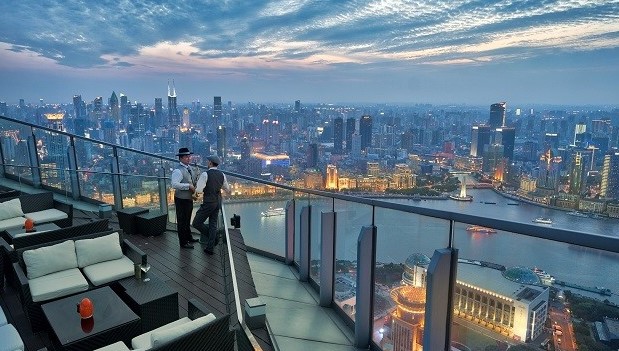
You’ve just spent forty-five minutes jostling through a sea of selfie sticks at street level, your view of the cathedral obscured by a double-decker bus and the persistent smell of exhaust fumes. Your feet ache, your map is damp with sweat, and you realize you haven’t actually seen the city yet—you’ve only seen its ankles. This is the “Ground-Level Trap” that swallows millions of tourists every year.
But then, you find that inconspicuous side door, ride a cramped service elevator to the 52nd floor, and step out into the crisp, biting air of a terrace. Suddenly, the chaotic noise of the metropolis turns into a distant, rhythmic hum. Over my decade of wandering the globe, I’ve learned that the true geometry of a city only reveals itself from above. Participating in city rooftop tours isn’t just about a pretty view; it’s about understanding the urban “circulatory system” from a vantage point most people never find.
The Vertical Shift: Why City Rooftop Tours are Trending
In the world of urban exploration, we talk about “The Third Dimension.” While most travelers navigate on a 2D plane—moving from Point A to Point B on a flat map—the most seasoned explorers look for the Z-axis. City rooftop tours have evolved from simple bar-hopping to deep-dive architectural and historical journeys across the “Fifth Facade” (a technical term architects use for the roof).
Think of a city like a giant, complex motherboard. From the street, you only see the tall capacitors and the heat sinks. From the roof, you see the intricate copper traces and how every block connects to the next. It’s the difference between looking at a painting through a keyhole and seeing the whole canvas at once.
Decoding the Urban “Heat Island”
One fascinating technical aspect I’ve discussed with local guides in New York and Tokyo is the Urban Heat Island (UHI) effect. Many modern rooftop tours now focus on “Green Roofs”—massive agricultural or botanical installations designed to lower building temperatures. Seeing a forest growing on top of a skyscraper isn’t just an Instagram moment; it’s a look at the future of sustainable urban engineering.
Top Destinations for Skyline Mastery
If you’re ready to ascend, these three cities offer the most technically diverse and visually stunning city rooftop tours currently available.
1. New York City: The Steel Canyons
NYC is the undisputed heavyweight of verticality. While most tourists flock to the Empire State Building, I always recommend the “Cathedral Heights” tours or the hidden terraces of the Meatpacking District.
-
The Sightline: You get to see the “Art Deco” setbacks of the 1920s buildings up close—details that were designed to be seen by pilots, not pedestrians.
-
Insight: I once spent an afternoon on a private roof in Long Island City just to watch the “Manhattanhenge” sunset. Seeing the light perfectly bisect the grid from an elevated position is a spiritual experience for any data nerd.
2. Paris: The Zinc Ocean
Parisian city rooftop tours are unique because of the strict “Haussmann” height limits. Instead of glass towers, you are greeted by a sea of grey zinc roofs and terracotta chimney pots.
-
Technical Context: These roofs are sloped at specific angles (usually 45 degrees) to allow for the iconic “Mansard” windows.
-
Experience: Walking the roof of the Galeries Lafayette or the Pompidou Center provides a “topographical” map of history, where the Eiffel Tower acts as your North Star in a sea of limestone.
3. Bangkok: The Neon Jungle
For a more modern, high-intensity experience, Bangkok’s vertical scene is unmatched. The city has some of the highest “Infinity Pools” and open-air platforms in the world.
-
Atmospheric Pressure: In Bangkok, the air changes as you go up. The “Smog Layer” often sits around the 20th floor; once you break through to the 60th or 70th, the air becomes surprisingly clear and cool.
Navigating the Technicalities of the Heights
For beginners, the transition from street to sky involves more than just an elevator ride. You need to understand the “Vertical Logistics.”
The “Wind Tunnel” Effect
Have you ever noticed how it can be a calm day at the hotel entrance, but the moment you step onto the roof, you’re hit by a gale? This is the Venturi Effect. As wind hits tall buildings, it is forced through narrow gaps between towers, causing it to accelerate. When booking city rooftop tours, always check the wind forecast, not just the rain. A 15 mph wind at street level can feel like a 40 mph gust at 800 feet.
Scheduling Your Ascent: The Golden Hour vs. The Blue Hour
In photography and travel blogging, timing is a technical requirement.
-
Golden Hour: The hour before sunset. This creates long shadows and “warm” tones, perfect for highlighting architectural textures.
-
Blue Hour: The 30 minutes after the sun goes down but before it’s pitch black. This is when the city’s electrical grid truly shines, creating a high-contrast “Cyberpunk” aesthetic.
Essential Gear for the Urban Climber
I’ve learned the hard way that the roof is a different climate. My packing list for city rooftop tours is lean but specific:
-
Circular Polarizer (CPL) Filter: If you’re shooting through glass (like at the Burj Khalifa or The Shard), a CPL is non-negotiable. It cuts out the reflections of the gift shop behind you so you can actually see the city.
-
Tethered Gear: I’ve seen enough $1,000 smartphones fall into the abyss to know that a wrist strap is your best friend.
-
Light Windbreaker: Even in the tropics, the temperature drops significantly as you gain altitude.
-
Prime Lens: For night shots, a lens with a wide aperture (f/1.8 or f/2.8) is essential for capturing the city lights without a grainy “ISO noise” mess.
Expert Advice: Tips Pro & Hidden Warnings
Tips Pro: The “Service Entrance” Secret
Many of the best views in European cities aren’t on official tour maps. Look for “Rooftop Libraries” or “University Terraces.” In places like Delft or Helsinki, public buildings often have accessible roofs that are free to enter and completely devoid of tourists. It’s the “Local’s Loophole.”
The “Acrophobia” Factor
Even if you don’t think you have a fear of heights, “Visual Vertigo” can hit when you are on a roof with a transparent floor or a low railing. Pacing is key. Don’t rush to the edge immediately. Let your inner ear calibrate to the new horizon for five minutes before you start looking straight down.
The Ethics of Vertical Tourism
As city rooftop tours become more popular, we have to consider “Privacy Pollution.” When you are high up, you are often looking directly into people’s apartments or private offices. As a rule of thumb, I always tell my readers: “The Skyline is public, the Balcony is private.” Avoid using telephoto lenses to peek into residential windows; focus on the broader urban tapestry instead.
Conclusion: Perspective is Everything
Walking the streets of a city gives you its stories, but standing on its roof gives you its soul. City rooftop tours strip away the grit and the frustration of the commute, leaving you with a sense of wonder at what human beings are capable of building. It’s a reminder that even the most chaotic city has an underlying order—a rhythm that can only be heard from the sky.
What’s the highest point you’ve ever reached in a city, and did it change the way you felt about that destination? Let’s talk about your favorite skylines in the comments!
