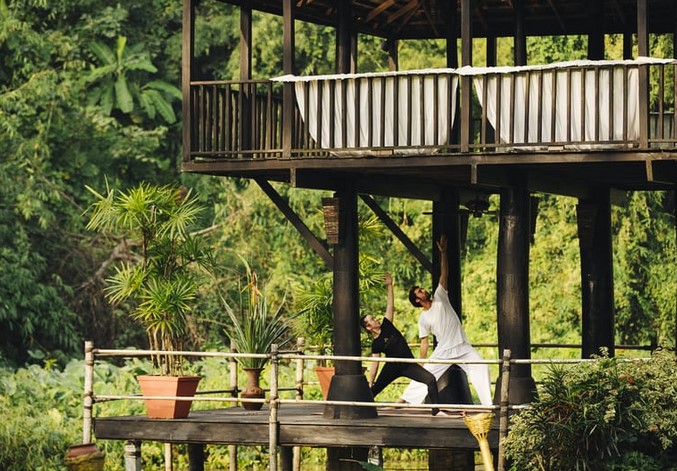
Your laptop screen is a glaring white rectangle of “urgent” emails, your phone is buzzing with notifications from apps you don’t even remember downloading, and your cortisol levels are likely high enough to power a small city. We’ve all been there—that “digital burnout” wall where a standard weekend at home just isn’t enough to reset the nervous system. According to recent travel data, the wellness tourism sector is growing at twice the rate of general tourism, and for a good reason: we are starving for silence.
In my decade of traversing the globe—from the neon-lit streets of Tokyo to the silent fjords of Norway—nothing has recalibrated my internal compass quite like a deep-dive into wellness jungle retreats. I remember sitting on a yoga deck in the heart of the Amazon, the humidity feeling like a warm, heavy blanket, and realizing that the chaotic symphony of insects was actually more soothing than the “calm” playlists on my phone.
But here’s the thing: not all “jungles” are created equal, and not every “retreat” is actually good for your health. If you’re a beginner looking for your first escape or an intermediate seeker wanting a deeper experience, you need to understand the science behind the scenery.
The Biological Power of the Canopy
Think of a wellness jungle retreat as a biological hard-drive defragmentation. In the city, your brain is constantly processing “artificial” stimuli—car horns, flashing lights, and sharp angles. In the jungle, the stimuli are “fractal.”
Fractals are complex, repeating patterns found in ferns, tree branches, and river systems. Technically, viewing fractals can reduce stress levels by up to 60% because our eyes are evolutionarily designed to process these specific shapes with zero effort. When you step into a jungle, your visual system finally gets to “relax” into its natural state.
The “Phytoncide” Factor
One technical detail I always look for when vetting a retreat is the density of the surrounding primary forest. Trees emit organic compounds called phytoncides (essential oils) to protect themselves from insects and rot. When we breathe these in, our bodies increase the production of “Natural Killer” (NK) cells—the white blood cells that fight off infections and even tumors. A true jungle retreat isn’t just a vacation; it’s an immune system upgrade.
Navigating the Map: Where to Find True Wellness Jungle Retreats
If you’re ready to trade your morning latte for a cup of herbal infusion under a teak canopy, these are the regions currently leading the world in high-quality wellness jungle retreats.
1. Bali, Indonesia: The Heart of Holistic Healing
Bali—specifically the Ubud and Tabanan regions—is the undisputed gold standard. But avoid the “Instagram-famous” spots that are more about the photos than the practice.
-
The Experience: Look for retreats that integrate Bali Usada (traditional healing) and Melukat (water purification rituals).
-
My Insight: I’ve found that the best retreats are those located near “Holy Springs.” The negative ion concentration near moving water in the jungle significantly enhances the meditative state.
-
LSI Keywords: Ayurvedic treatments, Sound healing, Pranayama sessions.
2. Costa Rica: The Biodiversity Sanctuary
Costa Rica’s “Pura Vida” philosophy is practically built into the soil.
-
The Experience: These retreats often focus on Ecopsychology. You aren’t just doing yoga; you’re engaging in “Forest Bathing” (Shinrin-yoku) guided by biologists who explain the interconnectedness of the ecosystem.
-
Pro Tip: Look for retreats on the Nicoya Peninsula—one of the world’s “Blue Zones” where people live significantly longer, healthier lives.
3. The Peruvian Amazon: The Deep-Dive
This is for the intermediate traveler looking for an intense, transformational experience.
-
The Experience: These often revolve around ethnobotanical medicine and ancestral wisdom.
-
The Technical Edge: Many of these lodges are built using Vernacular Architecture—structures that use no nails or synthetic materials, allowing the earth’s natural magnetic field to remain undisturbed.
How to Spot a Genuine Retreat vs. a “Greenwashed” Resort
With the rise in popularity of wellness jungle retreats, “Greenwashing” is at an all-time high. To ensure your money is funding your health and not just a marketing budget, look for these markers:
-
The Lighting Ratio: Does the retreat use high-lumen LED lights at night? A true wellness retreat respects your Circadian Rhythm. Blue light at 9:00 PM in the jungle is a technical failure. Look for properties that use “warm-spectrum” lighting or candle-lit evenings.
-
The Menu Sourcing: If they are serving imported salmon in the middle of a Costa Rican rainforest, the “wellness” is superficial. True retreats practice Permaculture, where 70% of your plate comes from the forest floor around you.
-
The Soundscape: Does the retreat have a “No-Tech” policy in common areas? A wellness retreat where everyone is staring at iPads during dinner is just a hotel with trees.
Expert Advice: Tips and Hidden Warnings
After a decade of sleeping in everything from luxury pods to hammocks, here is my “Blogger’s Bible” for the jungle.
Tips Pro: The “Acclimatization” Window
Never start your retreat programming (intensive yoga or detox) the moment you land. The “Jungle Transition” takes roughly 48 hours. Your body needs to adjust to the humidity and the different microbial environment. I always arrive two days early just to “sit” and let my heart rate sync with the environment.
Hidden Warning: The “Detox” Trap
Be very careful with retreats that promise “Rapid Detox” through extreme juice fasts in a high-humidity environment. Warning: Dehydration and electrolyte imbalance happen twice as fast in the jungle. Ensure your retreat has a resident nutritionist or medical staff who understands High-Altitude/High-Humidity physiology.
The “Bug” Reality Check
Let’s be honest: the jungle has bugs. A genuine wellness retreat will use Natural Repellents (like citronella or neem) rather than heavy DEET. If a retreat claims to be “100% bug-free,” they are likely using heavy pesticides that you will end up breathing in during your “wellness” stay.
Scannable Checklist for Your Jungle Retreat
Before you book your wellness jungle retreats, ensure they check these boxes for mobile-friendly reading:
-
[ ] Circadian-Friendly: Does the property minimize light pollution?
-
[ ] Sound-Path Integration: Is the yoga shala located away from generator noise?
-
[ ] Micro-Climate Comfort: Does the architecture allow for natural cross-ventilation?
-
[ ] Community Connection: Is the staff comprised of local residents who understand the forest?
-
[ ] Water Purity: Do they use UV-filtration or reverse osmosis for drinking water?
Summary: Finding Your Natural Frequency
We live in a world that is “always on,” but our biology is designed for “seasonal off-beats.” Stepping into wellness jungle retreats is an act of rebellion against the clock. It’s a chance to remember that you are a biological being, not a productivity machine.
Whether you are seeking the misty highlands of Southeast Asia or the dense foliage of Central America, the jungle is ready to hold space for your healing. Just remember to listen more than you talk, and breathe deeper than you think you need to.
Are you someone who thrives in the lush heat of the jungle, or do you find the “wild” a bit intimidating? Have you found a hidden retreat that changed your life? Share your stories in the comments—I’d love to know where you find your balance!
